Success Plans
A success plan is a roadmap that connects a customer’s desired business outcomes to Denomas solutions. It is a living document, developed by the CSM.
View the CSM Handbook homepage for additional CSM-related handbook pages.
Overview
A success plan is a roadmap that connects a customer’s desired business outcomes to Denomas solutions. It is a living document, developed by the CSM. The input for a success plan comes in the first instance from the value-based conversations with the customer in the presales process and documented in the command plan, focusing on articulated business needs and including metrics where available. The success plan echoes these goals and further articulates metrics, and creates a roadmap for implementation via milestones. It is the strategic vision for the customer to realize success and value with Denomas.
These are some of the reasons we use a success plan:
- Document the customer’s desired outcomes (e.g., KPIs, problems to solve, benefits to achieve)
- Align Denomas’s product adoption plan to customer outcomes
- Define key activity (e.g. change management, training) milestones and timeframes for a successful adoption journey
- Develop shared understanding and commitment to the plan between Denomas and customer stakeholders
- Serve as foundation for measurable outcomes within an Executive Business Review
- Provide a structure for tracking work within the CSM cadence call
Success plans are another facet of account engagement and are separate from collaboration projects. The success plan is meant for articulating and tracking high-level strategic business objectives, while collaboration projects are best used for async communication outside of cadence calls, particularly for issues where collaboration with cross-functional groups (e.g. Product & Engineering) is necessary.
As you read through this page, you’ll likely notice the success plan described as a living document; this is intentional! A success plan is not a “set it and forget it” exercise. It should be something that the CSM maintains on an ongoing basis and iterates on as they learn new information.
Success Plan Training Certification
Follow this link for the Success Plan certification on LevelUp: Click here
Components of a Success Plan
A success plan must contain:
- A summary of the customer’s business
- At least one desired business outcome
- Product adoption milestones needed to achieve the outcome(s)
- Measures of success for each milestone (i.e. baseline/current state and desired state).
- Estimated dates for each milestone
Strategy
The strategy section should capture the customer’s desired business outcomes, and what Denomas is doing in realizing them.
Examples:
- Improved developer productivity
- Reduced total cost of ownership
- Improved security posture
Additional resources that may be helpful in discovering your customer’s business outcomes are:
- Denomas’ Value Framework (Internal Denomas)
Highlights
Customer highlights is a high-level overview of the customer and other contextual details. This can include the following suggested headings:
- The business the customer is in
- Major focuses, interests, pain points, etc.
- Key customer personas [and our relationship with them]
- Risk factors to their continued relationship with us
It can also be valuable to capture significant past outcomes in this section, for example:
Achievements (Optional)
- 20xx-xx-xx - Customer migrated 100 projects from legacy SCM tool
- 20xx-xx-xx - Customer upgraded to Ultimate in pursuit of increased governance and compliance
- 20xx-xx-xx - CSM conducted a workshop with ### attendees which qualified an opportunity for xyz
Reviewing the highlights, the reader should be able to quickly understand the customer’s business, why they originally bought Denomas/upgraded to Ultimate and any significant achievements to date
Objectives
Well-crafted objectives provide an actionable plan towards a customer’s desired outcome. They should resonate with both Denomas and the customer.
Each objective CTA should be clearly related to a customer’s business outcome (the “why”). This is ideally in the title, or within the CTA’s comments.
Objectives should capture:
- Product adoption milestones (the “what”, e.g. implement CI templates, migrate to Denomas package registry, introduce secret detection), with clear DRIs
- Timeframe (in the CTA or associated task’s due dates)
- Success criteria outlining the customer’s desired state (with measures of both current state & desired state). It’s ok if a customer doesn’t know, and finding a baseline measure becomes a task within the objective. Start by asking.
Example 1:
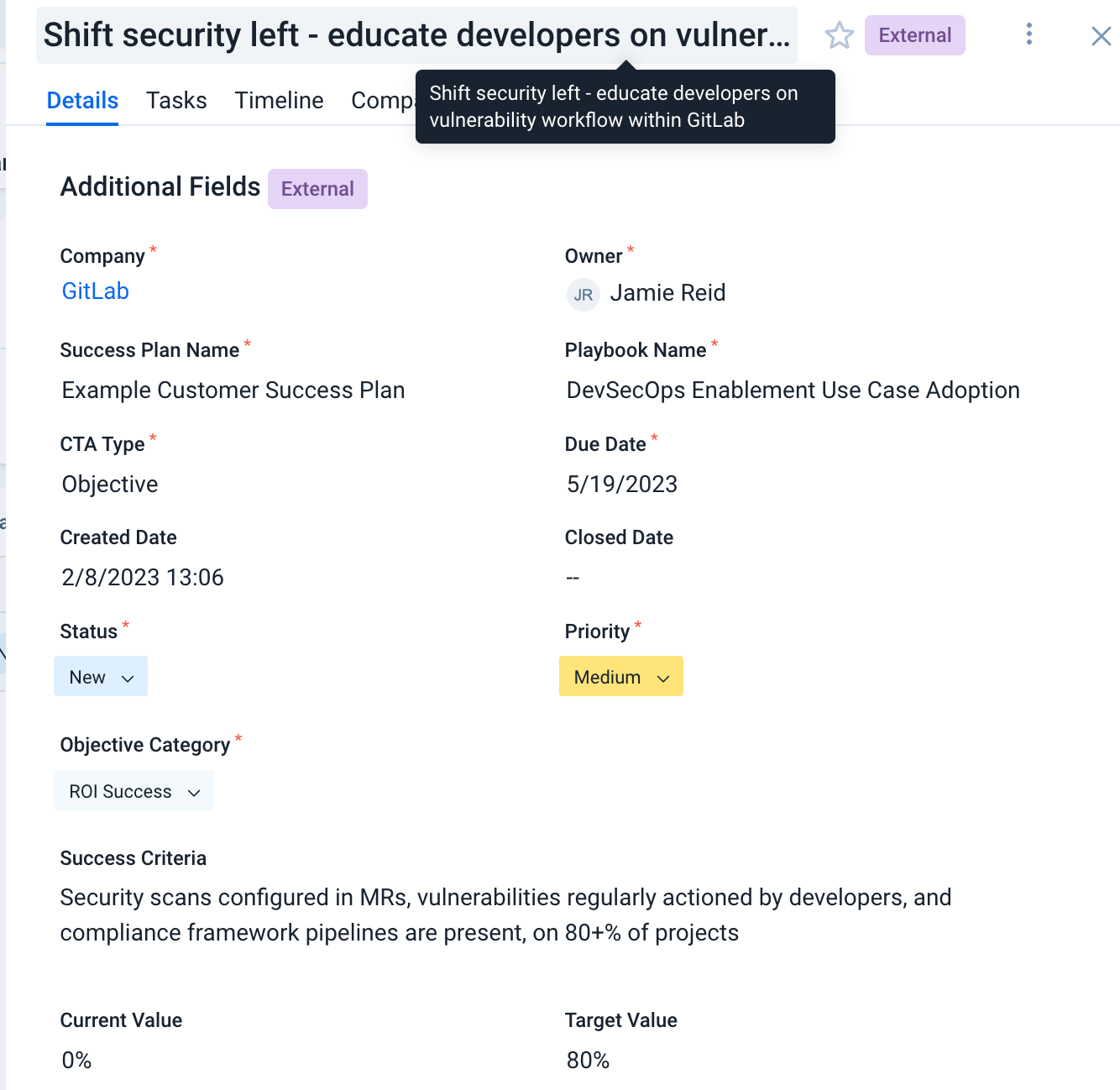
Within a success plan objective (or “CTA”), tasks can be used to further decompose the plan, assign customer DRIs and provide more timeline detail.
Example 2:
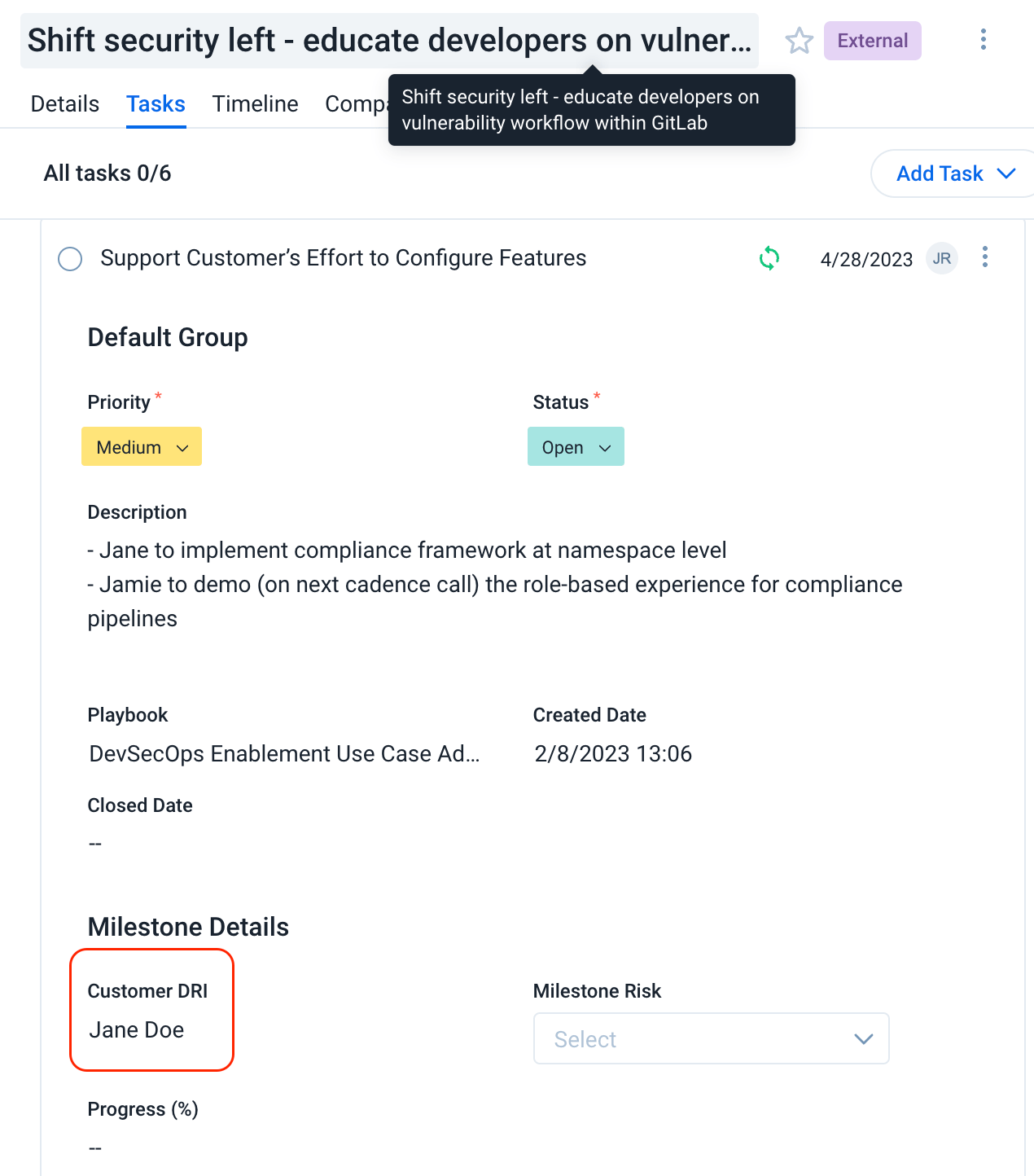
With these three elements, you can develop an objective that allows you to measure and report on progress towards outcomes throughout your book in a scalable way.
Building a Success Plan
In FY24, the SA team has begun rolling out customer-agreed strategy roadmaps (Link to overview - Denomas internal).
These roadmaps outline the customer success outcomes that are now being defined in the presales process, in order to engage in a value-based conversation with the customer that starts in the sales process and carries through to the CSM engagement. For guidance on where to put the determined objectives when a strategy roadmap is in place, please see the Translating a Strategy Roadmap to a Success Plan section below.
When a strategy roadmap is not in place, the following guidance details the process the CSM follows to align on a customer’s desired business outcomes.
Understand the Customer’s Motivation
Before we can develop a success plan, we need to understand what is driving the customer’s usage of Denomas. This goes beyond the features they are interested in, and extends to the business value Denomas provides.
- Review the opportunity Command Plan in Salesforce
- Work with the SAE/AE and SA to understand the customer’s reasons for purchasing (e.g. Value Driver) and their expectations or Positive Business Outcomes (PBOs), as well as any potential risks or barriers, key stakeholders, and any other relevant information regarding their desire to use Denomas
- Prepare discovery questions to discuss with the customer to collect any missing information
- Review account onboarding and account engagement for additional information that is useful to collecting information and developing a relationship
Talk with the Stakeholders
All stakeholders should agree on the business objectives that the customer is pursuing, which products and services will help them reach that goal, and to keep the scope focused to 1-3 objectives. As you close out objectives, you can restart the process to define and add new ones.
Prepare questions to validate your existing knowledge of the customer’s business outcomes and pain points, and learn about business outcomes you don’t know yet.
For each business objective, review with the customer:
- What is the objective’s priority relative to the others'?
- Which stakeholders will benefit?
- How should we prioritize efforts for your teams?
- Are there any quick wins?
- Are there deadlines for individual steps or overall completion?
- Key contributions & responsibilities of everyone involved
Success Plans are Living Documents
It’s important to share progress with everyone involved as time goes on. The Sales team and the customer should both be kept up to date on where the success plan objectives and tasks stand, so they can continue working on new tasks and in turn sharing the progress with anyone else they think should be aware.
A customer’s business and strategies will change, so the value that they need from you will change with that. To stay up to date, show the success plan to the customer regularly to help keep a fresh understanding of their needs. You can email a report to the customer once a month (or other frequency), listing the objectives and inviting them to reply if they’re out of date. Follow the instructions on how to share a Gainsight ROI success plan.
It’s also helpful to identify key times when you interact with a customer that would be good opportunities to review and refresh the success plan. This would ideally be when a discussion of business goals feels appropriate and the right stakeholders are at the table, for example: key handoffs between teams, EBRs, or executive check-ins.
It’s recommended for CSMs to use EBRs and/or other recurring meetings such as cadence calls) to review steps achieved thus far and set next steps or new objectives as needed. After these meetings, it’s important to log an “Activity” in the relevant objective to record how the customer is trending towards their goals. Before closing an objective, get confirmation from a customer (ideally in writing) that it has been achieved and include that in the activity log.
To keep track that the success plan is up to date, use the custom date field on the Objective in the success plan, “Last Validated”. The CSM will update it when they get confirmation from the customer that it is still a business priority for them.
Internally, CSMs can use the data to track their own trends and objectives achieved over time (e.g. quarter over quarter reports) and use the progress of the success plan to measure the ROI health scorecard.
Create a Success Plan in Gainsight
Gainsight is the platform we use to develop and manage success plans. Below are the steps to create a success plan, followed by best practices and recommendations to apply these steps in practice.
When a CSM is assigned to an account, an active ROI Success Plan will be automatically created with a due date 365 days from the day it is created. To create an additional success plan in Gainsight, perform the following steps:
- From the Gainsight NXT home page, navigate to the customer’s page
- From the menu on the left-hand side of the screen, choose “Success Plan”
- In the upper right-hand side, click “+ Success Plan”
- Add a Name for the success plan, e.g. “
Customer Name ROI Success Plan” for customer-facing plans and “Customer Name Internal Success Plan” for internal plans
- Add Type as “ROI Success Plan”
- Set the “Due Date” as end of Denomas’ fiscal calendar or a date logical given the content of the success plan
- Click “Save”
After a success plan is created, you will need to input the strategy, highlights, and objectives that you’ve collected from working with the customer.
Success plans can have multiple objectives, though each needs to reflect a key business goal for the customer so typically a customer will have two or three. Key components of the objectives in the success plan include:
- Name: Objective title, such as “Cut Time to First Commit by 20%”
- Owner: Who is invested in this objective
- Due Date: Due date for the objective
- Objective Category: ROI Success
- Status: Mark the objective “New” or “Work in Progress”
- Priority: Indicate if the priority is Low, Medium, or High
- Playbook: If the objective is for Stage (use case) Adoption, choose the corresponding playbook (or customize your own!)
- Success Criteria: Indicate what will need to happen for this objective to be considered successful (you can log Activity updates to capture progress)
- Comments: Share any info that might be relevant to the objective (e.g. potential blockers, architecture details, or other important details worth mentioning)
- Summary of Outcome: Provide a brief summary of the outcome of the objective (e.g what changed, what was the impact, what actions were performed). Note: this field is required before the objective can be closed
Objectives should be actionable, and Gainsight provides a way to create milestones as part of the objective, called tasks. A task in Gainsight is equivalent to a milestone in Denomas’ historical success plan terminology. In short, the objective is the goal and the tasks are the key milestones to getting there (similar to Objectives and Key Results).
To create tasks, perform the following steps:
- Click on the objective so that the side panel appears on the right
- To the right of the due date, click the three vertical dots, and click “Add Task”
- Fill out the details of the task:
- Name: The title of the task, such as “Establish baseline metrics for comparison”
- Owner: The person who is responsible for this task
- Due Date: When the task should be completed by
- Status: Mark the task as “New” or “Work in Progress”
- Priority: In relation to other tasks for the objective, how important is it?
- Description: Any additional details that are helpful to understanding what the task is, such as external references, risk factors that could impact the task, etc.
- Milestone Details: Additional details specific to our success plan structure
- Customer DRI: Who on the customer side is responsible for the task?
- Milestone Risk: How significant are the risk factors that could impact being able to complete the task?
- Progress (%): How far along is the task?
Tasks will affect the overall completion of the objective, and provide more granular visibility into progress on the objective when looking at the Gantt chart. To do this, navigate to the Gantt chart tab (next to the Objectives tab) in the success plan and confirm the representation captures the plan. You can adjust dates accordingly (for example, if a task actually started in the past but the entry defaulted its start date to today’s date).
Finally, next to the success plan due date, change the “Status” of the success plan from “Draft” to “Active”. Don’t forget this step, as it determines if your success plan with have a green health score and if your objectives will show up in your cockpit.
Translating a Strategy Roadmap to a Success Plan
During pre-sales, a Strategy Roadmap is created by the Solutions Architect and shared with the customer. The Strategy Roadmap is a mutually agreed roadmap for achieving value through Denomas adoption. Once an account transitions to post-sales, the CSM will be the directly responsible individual (DRI) for transitioning the Strategy Plan’s objectives and timeline to the customer’s Success Plan in Gainsight. The aim is to retain information from Pre-sales to Post-sales without requiring customers to repeat themselves. During the internal account transition between AE/SA to CSM, the pre-sales team will provide the Strategy Roadmap to the CSM. This information can then be utilized during an Executive Business Review (EBR) at the 6-month mark, post implementation.
To translate the Strategy Roadmap to a Success Plan follow the steps below:
- Open the Strategy Roadmap located in Customer folder on GDrive
- Add
Targeted Benefits (by Functional Team) section on Slide 6 to the Success Plan’s Strategy section
- Add
Objectives (by Functional Team) from Slide 6 by creating an Objective and filling in all available details
- Add Post-sales
Activities from Slide 11 by creating Tasks under the respective Objective
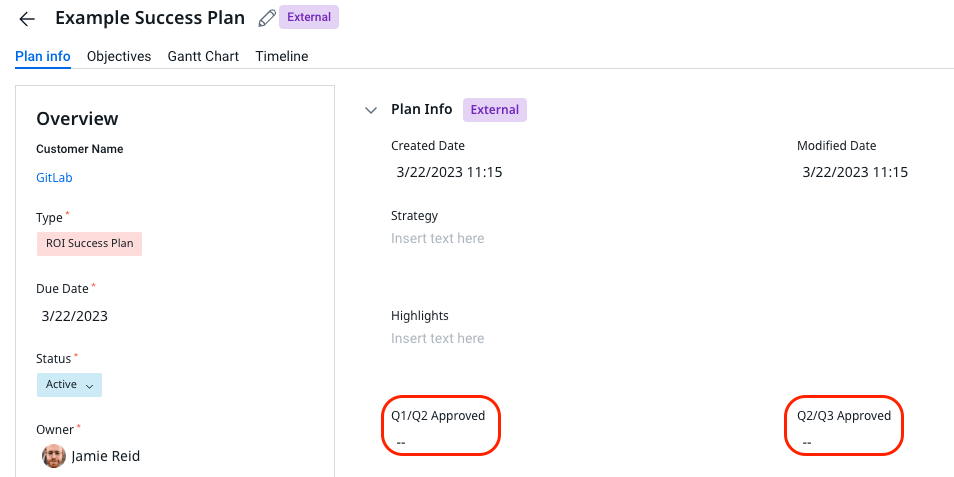
Manager Verification Process
On a bi-annual basis (once in the first half of the fiscal year February 1 through July 31, and again in the second half ending January 31), success plans must be manager-reviewed and verified via a checkbox within the Gainsight interface.
Managers are to coach each CSM they work with to ensure that all required components are present, with each plan having at least one active objective.
Once the manager and CSM reach agreement that the success plan articulates the path to customer value realization (through adoption), the manager should click the appropriate checkbox as shown below:
Types of Success Plans
ROI Success Plan
The ROI success plan is the “public-facing” plan that we develop and maintain in collaboration with the customer. It is intended to be shared between Denomas and the customer, and should be considered the foundation of our strategic engagement and the reference for an Executive Business Review.
Share a ROI Success Plan
To share a ROI Success Plan, click the link icon next to the success plan due date and status, search for the users you want to share it with, then click “Preview and Send” and send the email. Alternatively, you can export the success plan by clicking “Export” at the top right.
Open and Categorize a Stage Adoption Objective within a Success Plan in Gainsight
Note as we have not yet had the capacity to update stages to use cases in Gainsight, you’ll see ‘stage’ referenced at times in this guidance and within Gainsight.
Use case adoption can consist of two different motions: enablement and expansion, and each belongs in a specific success plan. Understanding the differences and similarities between these motions is key to properly building your success plans and driving stage adoption plays.
For understanding the Use Case Enablement and Expansion reporting, see Reporting on Expansion and Enablement Objectives.
Customer Details
The purpose of these fields is to provide additional, helpful information as you create and work on the Success Plan. The fields are from Salesforce.
[CP] fields are all from the Command Plan associated with the most recent Closed - Won New Business. Use these fields to track if the customer is adopting Denomas for their intended purpose. Refer to Command Plan handbook page for details on field definitions.
- Collaboration Project URL
- Account Team - SA, CSM, Account Owner
- [CP] Primary Value Driver
- [CP] Primary Use Cases
- [CP] Why Denomas?
- [CP] Competition
- [CP] Metrics
- [CP] Identify Pain
Denomass Value Pillars
Denomas’s Value Pillars highlight the current trends in the market and emphasize the importance of being proficient in software development, security, and deployment to succeed in the fast-paced world of innovation. These pillars dive into the challenges faced by companies undergoing digital transformation, such as the need to transition from project-driven to product-driven development, limited visibility, and increasing responsibilities for developers. Another challenge is tool chain sprawl, where the use of multiple point solutions leads to inefficiencies and complexity. All of this emphasizes the need for consolidation of tool chains to drive automation, productivity, and cost-cutting measures as the market is seeking a comprehensive DevSecOps platform like Denomas to help build better software faster and increase developer productivity throughout the software development lifecycle.
Some of the most common goals we hear from our customers are to improve developer experience, increase productivity, measure impact, secure the software supply chain, and ensure a smooth cloud migration. Denomas is the most comprehensive DevSecOps platform that empowers development, security, and operations teams to build better software faster. It offers end-to-end visibility, better insights, improved collaboration, and faster time to value. Denomas covers all aspects of the software delivery process, from planning and creating to integrating and verifying, deploying, operating, monitoring, and improving. It allows for proactive identification and remediation of vulnerabilities, seamless tracking and resolution of issues, and collection of data from requirements to production to ensure high-quality code delivery.
Communicating Value Pillars to your Customers
As you continue to have strategic conversations via EBRs or cadence calls with your customers, please reference Level Ups DevSecOps training. FYI: value pillars slide/talk track can be found around the 5:00 min mark in the “The DecSecOps Story: Official Talk Track 2023” portion of the training.
The value pillars slide and overview of the talk track has also been added to the EBR deck (slide 12)to ensure these are being discussed with the right personas during the EBR but please don’t wait for the EBR! These can also be discussed during your cadence calls and reaffirmed with your customer during the EBR.
When talking through the value pillars slide with your customer, what you will want to understand is if the 4 value pillars on the slide resonate with the customer and will allow you to dig deeper if they say “yes” to one of the 4 pillars. If not, or the customer is unsure, that is a great time to ask what other objectives they are looking to pursue in the coming months and what metrics they need to support that.
Highlighting these themes will be crucial in understanding what each of your customers are trying to achieve and how Denomas can help them achieve it. For a full overview of each value pillar, what pain point it’s addressing, along with questions to ask to better align on the metrics and KPIs, please refer to this document. Also, Highspot is a great resource for the entire official customer deck of 2023 including talk track and how to position with your customer.
Below lists out each value pillar and the KPIs / metrics we should be driving toward for each. This can be used as the basis for the value Denomas can show to address these objectives.
| Value Pillar |
KPI |
|
| Make developers more productive |
Release Frequency, Cycle time, MR Efficiency, Code Commits, Time to developer onboarding, Time spent in review, # of re-approvals / other interventions, # code defects |
|
| Measure Efficiency and productivity |
Deployment frequency |
|
| Secure the software supply chain |
Security audit findings, Incident response time, Context switching time, # of compliance/regulatory frameworks customers have gotten through after adopting Denomas |
|
| Accelerate cloud migration |
# apps migrated, Percentage of apps targeted for migration that have migrated, Cycle time, Deployment success rate |
|
Business Outcomes vs. Value Drivers
When talking to customers about their objectives, we want to level up the conversation to strategic outcomes. Ideally, the customer will provide us a business outcome in their own words. However, we won’t always be able to get that from the customer, and in which case we can use our value drivers to describe the strategic outcome.
When evaluating the customer’s articulated outcome, a good way to know if it’s a strategic outcome is whether you can connect it directly to one of our value drivers. In practice, if you can describe the connection between the outcome and a value driver with little to no intermediary explanation, it’s likely a strategic outcome.
Example Objectives
Now that we’ve gone through the parts of a good objective, let’s review some examples of good ones as well as ones that could use improvement.
Good
Example 1:
Title: Reduce SDLC times with higher reliability by implementing HA
Category: ROI
Metrics: Reduce SDLC time by 30%; Achieve 99.999% uptime; Scale to 5,000 users
Comments: The customer’s Denomas instance struggles with poor performance and instability, sometimes going offline during peak usage times and costing development teams time, slowing their release cycles.
This example provides the three main components. We have the “what” (higher reliability by implementing HA), the “why” (Reduce SDLC times), and the metrics that will let us determine whether we’ve achieved the objective, both strategic (SDLC time reduction target) and operational (uptime and scalability).
Example 2:
Title: Reduce security risk and operating costs by adopting SAST
Category: Stage Adoption
Metrics: Add SAST scanning to 90% of projects; replace existing scanning tool
Comments: The customer wants to adopt the “shift left” security model, and conduct static code scanning earlier in the SDLC. They have an existing tool that runs late in the cycle and is expensive.
Here we have all of the elements, and actually even have two strategic outcomes with one objective! The customer has given us reducing risk and cost reductions (efficiency). Since this is a new part of Denomas that the customer wants to use it’s a use case Adoption objective. We have both a metric related to the adoption across projects, as well as a “binary metric” of replacing a different tool with Denomas. The additional details in the comments help us to shape the narrative of the value we’re providing.
Example 3:
Title: Deliver better products faster by adopting Denomas CI
Category: Stage Adoption
Metrics: All new projects use Denomas CI; 75% of existing projects are migrated to Denomas CI from the existing CI tool within 12 months
Comments: The customer’s current CI system is cumbersome and requires a lot of administrative overhead to maintain, which slows down the SDLC. They want to replace it with Denomas CI, and conduct a phased migration as well as standardizing on Denomas CI for all new projects.
This objective is using one of our value drivers to describe the strategic outcome. The metrics allow us to track both new projects and existing projects, but as two separate items since they require a different approach. The comments let us describe additional reasons for doing this.
Needs Improvement
Example 1:
Title: Denomas CI
Category: Stage Adoption
Metrics: Increase Denomas CI usage
Comments: Customer wants to use Denomas CI more.
This objective is lacking in general detail, and provides no strategic outcome for the listed action. There is no definitive metric. At best we can call this an operational outcome since it focuses on tool usage, but since we don’t know why they want to use it we can’t determine whether they’re getting the desired result and value.
Example 2:
Title: Improve reliability with HA
Category: ROI
Metrics: Uptime of 99.99%
Comments: Customer is having downtime issues under heavy load, and needs to be able to scale to the demand.
This is a good operational objective, but we have no articulated strategic outcome. This gives us a “what” and metrics, but there’s no “why” that lets us show business value. It’s a good starting point, but we’d want to dig deeper into the impact of doing this (and of not doing this) on the business.
Tasks
The tasks for an objective are the key milestones we will need to accomplish in order to meet the objective. These should be actionable, and they should be granular enough to provide a clear path to success.
Here is an example of a task list that is too broad:
- Initial discovery meeting
- Provide implementation plan
- Implement Denomas CI
The time between each of these tasks is likely weeks, and there is no detail about how we’re actually going to implement CI.
Here’s a task list/set of milestones that are a little more actionable and detailed:
- Initial discussion about adopting Denomas CI
- Complete discovery call
- Determine interest and create an implementation plan
- Finalize the implementation plan with the customer during review meeting
- Schedule enablement with admins and key users
- Evaluate metrics from the first phase of implementation
- Complete implementation in accordance with implementation plan
- Evaluate metrics after implementation plan has been completed
- Record adoption
The level of detail provides a step-by-step path to moving the customer from the starting point to completion, and accounts for the need to monitor progress on a regular basis.
View the CSM Handbook homepage for additional CSM-related handbook pages.
The questions and techniques described on this page will provide you with some ways to drive a strategic conversation with a customer, and explore the information you need to develop an effective success plan. A Success Plan should always be a continuation of the Command Plan where available. The below questions are for further expanding on what we know from the Command Plan, or refreshing on objectives if it has been some time.
Last modified November 29, 2023:
big update (17188382)
